Tuesday, May 11, 2010

Sweetwater Market

Here are a couple of photos from Sweetwater Market. Our lovely sign was made by Hilde Muller, a friend and neighbor, who has worked on our farm and been a CSA member. She also made our price signs for the Market. We get a lot of compliments on them. Contact her if you are in need of something similar. She's quite talented.


Lisa Brown became a CSA member years ago, before she really liked many veggies, and now she works for us year-round in order to get as many fresh and stored veggies as possible, and she freezes and dries the extra! She's a gem!

We are indoors in the lobby of the Hackley Professional Building on Harvey Street if the weather is bad, or outside in the parking lot during fair weather.
Come visit us!


Friday, May 7, 2010

Celery


Baby plants in the Greenhouse


Eggplant and sweet and hot peppers in the greenhouse


Plants in the hoophouse to protect them from the rain and cold today. They will be transplanted into the gardens this next week.


Early tomatoes, blooming and with baby tomatoes already formed. They will go in the hoophouse in the next week and we will hope for no weather surprises! There's a heater in with them for the next few days.

The fruit garden: rhubarb, raspberries, blackberries, blueberries, strawberries, and cutting flowers - Sweet Williams, snap dragons, gladiolas

Baby spinaches

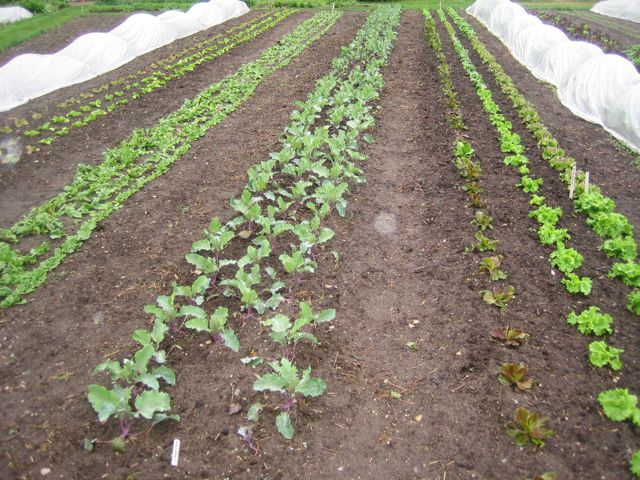
Many rows of early crops: lettuces, spinach, kohlrabis. Under the row covers are turnips, radishes, pak choi.

Baby carrots, cutting lettuces


Rainy, cold day today. Still beautiful and green!

Greenhouse work

All the tomatoes (about 700) are transplanted into cells now - at some point, I'll have to list the kinds. There must be 15 or 20 varieties. I will probably have some extra plants to sell at the Market or to share with people. I am sooo hungry for tomatoes - did not get my normal fill last year after the blight hit us.

We had a great work crew here yesterday and got the whole garden by the house weeded, cultivated, thinned. We harvested quite a bit of lettuces, spinach and radishes. Veggies are growing faster than normal because of the warm weather. If any of you are interested in an early CSA box, let me know.

Today, rainy, cold. Good day for Greenhouse work. This is what I planted: 50 cells each of Suhyo Long & General Lee cucumbers, Basil, mixed summer squashes, Petite Yellow watermelons, Hannah's Choice muskmelons; 72 cells each of Tendergreen broccoli, Ruby Perfection and Gonzalez cabbage, Buttercrunch and Anuenue head lettuce; plus channels of celery seed. I hope it's not too early for the cukes, squashes and melons!

Monday, April 26, 2010

CSA Shares

We have room for maybe 10 more families, and I've had 5 or 6 contact me in the last week wanting more information. If you are planning to join and haven't confirmed with me yet, better do so!

Farm Update

More is getting planted, and the larger harvests have begun! Because of the warmer weather, we picked 9# of spinach this morning, and 2.5# of salad greens! This is just what needed to be picked before picking again for Sweetwater Market on Friday. YUM!

We have tomato plants with blossoms!

Chickens got moved to their summer coop and pens. They are happy girls (and 1 guy).

Wednesday, April 14, 2010

Grass-Fed Beef Quarters for sale!

We just butchered and have the beef hanging to age and tenderize it. If you order in the next week, your quarter will have your name on each vacuum-packed package and will be cut and packaged however you desire. Prices are $400-$450 depending on individual hanging weights. It would be ready to pick up in 3 weeks.

Lots growing

We have the garden back here by the house almost full, and have planted a whole lot of the rest of the garden spots with early plants and seeds. Things seem to be coming up and growing well, except for the early kale and chard that was transplanted outside. It got zapped hard by cold and rain. Planted more seeds of both in the greenhouse.

Wednesday, April 7, 2010

Rainy -

We transplanted a lot of plants today: Piricicaba sprouting broccoli, Bright Lights Chard, Winterbor Kale, a few kinds of head lettuce: Michelle, Buttercrunch, Waldemann's, and Raddichio. More seeds have been planted in the greenhouse as the flats of early things are transplanted.

We have been hardening off plants (getting them used to outdoor weather after they've been growing in the greenhouse), but I moved them all back into the hoophouse or greenhouse because it's getting colder tomorrow - Sunday. All the plants in the ground should do ok.

We sent 4 steers in to get butchered. If you are interested in beef, let me know as soon as possible!

Monday, April 5, 2010

Onions and Potatoes, Oh My!

1000s of onion plants were put out today. Long rows, and we are trying them in black plastic this year. Small early onions, onion sets, Copra yellow onions, Red Bull and Redwing Red onions.
One 400 ft row of Red Norland early potatoes was planted.

Pak Choi was transplanted out and covered with row cover to keep the flea beetles off it. 200 plants.

Friday, April 2, 2010

Summer weather in early April!

Wow. It's actually too hot & windy to do some transplanting today! I had visions of putting out storage onions and pak choi. They will have to wait.

We transplanted about 100 ft of scallions that were started in the greenhouse 2 months ago. I'm watering them now. There's another tray growing that will be ready to transplant in a few weeks. Little tiny onion plants put 1-2 inches apart . . . . . . . . . . . . . . . . . .
All the peas are planted: Lincoln, Green Arrow and Coral shelling peas, Sugar Snap edible pod peas, and Oregon Giant snow peas. The fences are up and ready for them to climb. The tallest pea vines get about 6 ft tall.

Bill has been setting up the irrigation system at the Putney Farm next door. Plumbing ~~ his favorite thing to do - NOT!

Thursday, April 1, 2010

Photos from March 30th

A beautiful head of Bibb lettuce. This is growing in the hoophouse, planted last Fall.

Kale, transplanted into the hoophouse last Fall. We've been eating this regularly. YUM!

Raddichio, parsley, arugula, chicory, mixed lettuces. I picked these for Sweetwater Market on Saturday. Plus we had a huge salad and can pick these plants again in about 3 days.

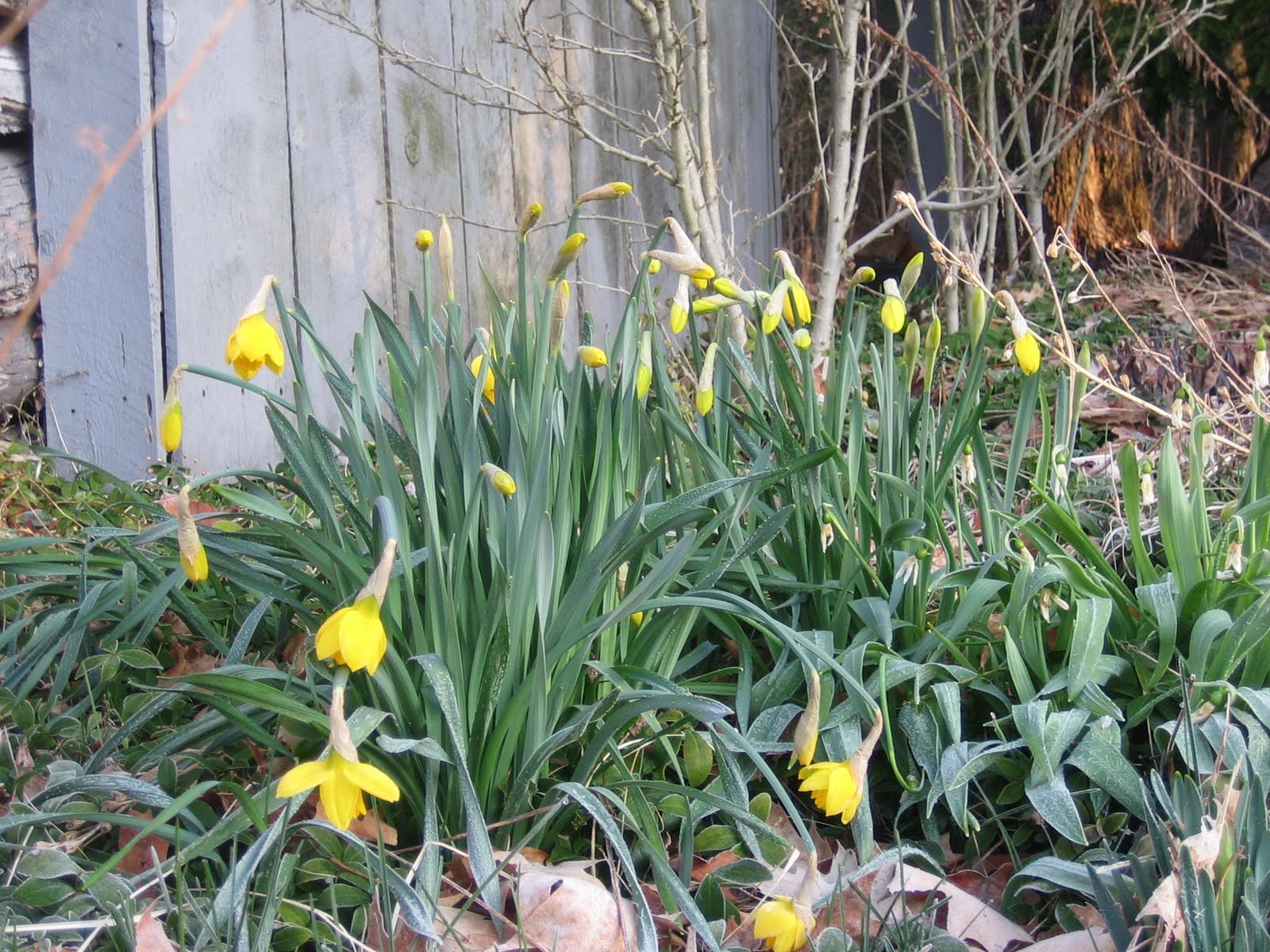
This patch of daffodills has been growing here for about 35 years. They get periodically thinned and spread around the farm and shared with others.

A frosty morning on the Farm. There's carrots, mixed lettuces, radishes, raddichio under the row covers, and a bunch more was planted yesterday.

Wednesday, March 31, 2010

Planting Planting Planting!

We put in about 30# of onion sets today. They look like tiny onions, the size of a fingernail, and will grow into a normal-sized bulb. We planted them in black plastic mulch this year - worth a try so it's less labor weeding and cultivating.
We planted many seeds directly into the ground: 2 kinds of spinach, Leaf Lettuces, 3 kinds of beets, turnips, carrots, 3 kinds of radishes, mustard greens, arugula. The first planting of radishes got thinned. The first planting of leaf lettuces and carrots are sprouting.
Plastic is layed for the peas, chard and kale. Hope to plant them in the next 2 days, along with the early potatoes.
More raddichio, 2 kinds of kale, romaines, and larkspur seeds were planted in the greenhouse.
This will be the first night I've left the trays of head lettuces out all night. The temperature is still 66℉ and it's 9:15 at night!
Oh, there's sooo much to do!

Monday, March 29, 2010

EGGS!

We have an abundance of eggs - $2.50 per dozen on the Farm, or $3 per dozen at Sweetwater Market. The chickens are loving all this warmer weather, fresh greens, sunshine. They have increased production!

Farm Update

Calves are being born! Fields are getting tilled! Maple Syrup set-up is cleaned up. It was a bust year for syrup - we made 5 gallons and should have made 25. It just got too warm.

Onion plants and lettuces, mustards, kales are all getting moved in and out of the greenhouse to harden them off. They need to gradually be conditioned to the outside weather after growing in the warmed and protected greenhouse.

Paths are getting trimmed back. The gardens are getting composted and tilled and ready to plant. We plan to start setting out onions (sets and plants) on Wednesday and also hope to plant peas that day. We need to prune the raspberries and some of the perennial shrubs still. The last of the wintered-over parsnips will be dug today.

Thursday, March 25, 2010

The past few days

I planted 300 sweet pepper seeds yesterday! Reds and greens and lilac and yellow. Long ones, blocky ones. I also planted a lot of hot peppers - some interesting varieties.
I also picked enough kale for dinner. Oh my, it was so tender and yummy! We can pick salad about every 2 - 3 days. Spring is here!

Friday, March 12, 2010

Beef Testimonial!

"We love it, Patrice! I have bought beef quarters/halves before, and have sometimes gotten ....shall we say, less than good quality. Not only is your beef great, but it is also good to know that it isn't coming from some commercial feed lot where the cattle are treated like meat machines! I am also glad to feed my family ground beef that isn't coming from a mix of a bazillion different steers."

Monday, March 8, 2010

Almost Spring Update from the Farm

The hoophouse is producing the first spinach and lettuces. We'd have more, but some little critter burrowed into the hoophouse about 3 or so weeks ago and ate almost all the spinach and some chard! I planted some small rows of radishes and carrots for us.

The greenhouse is filling up. All the allium family is planted: all the red and yellow onion seeds, leek seeds, the first full tray of scallion seeds, and it's time to start another tray. All the celeriac is seeded in cells, even though we haven't yet harvested all of last year's crop! It's probably the longest season veggie we grow. Lettuces were already large enough to transplant into the hoophouse. More are started, including head lettuces. The earliest plantings of kale, chard, mustards, sprouting broccoli, celery, about 60 early varieties of tomatoes, some hot and sweet peppers, parsley, basil and cilantro are all growing. More trays are planted almost every day. It's time to start kohlrabis- about 250 cells will be planted. We start a lot of the seeds indoors to transplant out in April and May so that you will have CSA veggies sooner. It's more work, but you are paying for that. To give you some idea of scale, here's some numbers of veggies planted indoors: 144 celery cells, nearly 300 celeriac cells, 144 cells of broccoli, over 200 head lettuces, etc etc etc.

We are also making maple syrup now - drew off the first few gallons today. We bought new pans and are still figuring out this system.

The sunny weather has been fantastic! It's so appreciated after snow and cold and especially cloudy days.

Sunday, March 7, 2010

The Spread of Superbugs

By NICHOLAS D. KRISTOF

Until three months ago, Thomas M. Dukes was a vigorous, healthy executive at a California plastics company. Then, over the course of a few days in December as he was planning his Christmas shopping, E. coli bacteria ravaged his body and tore his life apart.

Mr. Dukes is a reminder that as long as we’re examining our health care system, we need to scrutinize more than insurance companies. We also need to curb the way modern agribusiness madly overuses antibiotics, leaving them ineffective for sick humans.

Antibacterial drugs were revolutionary when they were introduced in the United States in 1936, virtually eliminating diseases like tuberculosis here and making surgery and childbirth far safer. But now we’re seeing increasing numbers of superbugs that survive antibiotics. One of the best-known — MRSA, a kind of staph infection — kills about 18,000 Americans annually. That’s more than die of AIDS.

Mr. Dukes, 52, picked up a kind of bacteria called ESBL-producing E. coli. While it’s conceivable that he touched a contaminated surface, a likely scenario is that he ate tainted meat, said Dr. Brad Spellberg, an infectious-diseases specialist and the author of “Rising Plague,” a book about antibiotic resistance.

Vegetarians are also vulnerable to antibiotic resistance nurtured in hog barns. Microbes swap genes, so antibiotic resistance developed in pigs can jump to microbes that infect humans in hospitals, locker rooms, schools or homes.

Routine use of antibiotics to raise livestock is widely seen as a major reason for the rise of superbugs. But Congress and the Obama administration have refused to curb agriculture’s addiction to antibiotics, apparently because of the power of the agribusiness lobby.

The ESBL E. coli initially remained in Mr. Dukes’s colon, causing no particular damage. But then he suffered an inflammation that perforated his colon — and the bacteria escaped.

Mr. Dukes began suffering stomach pains and saw his doctor, who gave him Cipro, a strong antibiotic that had previously worked against the infection. This time, the pain grew worse. The next evening, he was in surgery to remove eight inches of his colon.

A culture attributed the infection partly to ESBL E. coli. Doctors inserted a tube to administer an intravenous antibiotic in an effort to save his life.

If ESBL E. coli is frightening, there are even more potent superbugs emerging, like Acinetobacter.

“We are seeing infections caused by Acinetobacter and special bacteria called KPC Klebsiella that are literally resistant to every antibiotic that is F.D.A. approved,” Dr. Spellberg said. “These are untreatable infections. This is the first time since 1936, the year that sulfa hit the market in the U.S., that we have had this problem.”

The Infectious Diseases Society of America, an organization of doctors and scientists, has been bellowing alarms. It fears that we could slip back to a world in which we’re defenseless against bacterial diseases.

There’s broad agreement that doctors themselves overprescribe antibiotics — but also that a big part of the problem is factory farms. They feed low doses of antibiotics to hogs, cattle and poultry to make them grow faster.

A study by the Union of Concerned Scientists found that in the United States,

70 percent of antibiotics are used to feed healthy livestock, with 14 percent more used to treat sick livestock. Only about 16 percent are used to treat humans and their pets, the study found.

More antibiotics are fed to livestock in North Carolina alone than are given to humans in the entire United States, according to the peer-reviewed Medical Clinics of North America. It concluded that antibiotics in livestock feed were “a major component” in the rise of antibiotic resistance.

Legislation introduced by Louise Slaughter, a New Yorker who is the only microbiologist in the House of Representatives, would curb the routine use of antibiotics in farming. The bill has 104 co-sponsors, but agribusiness interests have blocked it in committee — and the Obama administration and the Senate have dodged the issue.

After weeks of receiving intravenous antibiotics, Mr. Dukes is now recovering at home in Lomita, Calif. He must use a colostomy bag, but he hopes to be patched up and ready to return to work next month. Still, he knows that the ESBL E. coli remains in his gut.

“As long as it’s contained in my colon, I’m a happy camper,” he said. “But if it gets out again, I’m in trouble.”

Dr. Martin J. Blaser, chairman of the department of medicine at New York University Langone Medical Center, and a former president of the Infectious Diseases Society of America, agrees that agricultural use of antibiotics produces cheaper meat. But he says the price may be an enormous toll in human health.

“You could have very lethal pandemics,” he said. “We’re brewing some perfect storms.”